

Let's be precise about costs. Not estimates. Not marketing claims. Real
numbers from installed systems, verified against utility bills,
maintenance records, and oxygen supplier invoices.
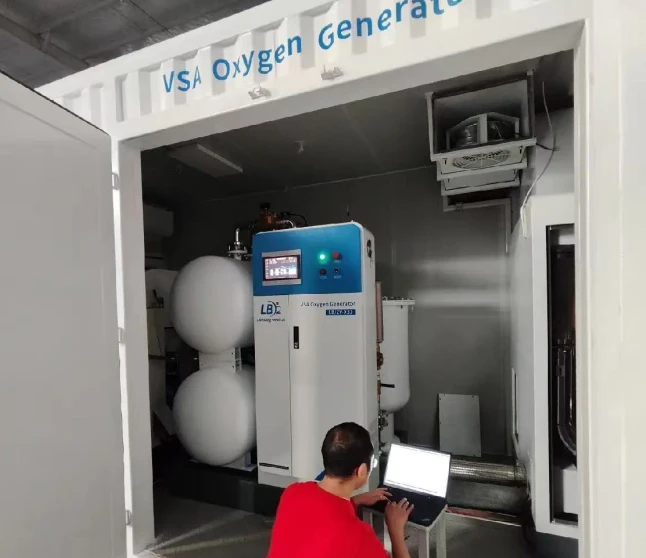
The VSA Cost Breakdown: $0.056 per Cubic Meter
Electricity: $0.042/m3
The system draws approximately 58 kW total to produce 40 Nm3/h of 93
percent oxygen. At actual average operating loads around 60 percent of
rated capacity, the intelligent control system optimizes power draw.
Measured average electricity consumption at a reference installation:
roughly 24 kWh per hour, translating to $1.68/hour at $0.07/kWh. At
average output of 24 Nm3/h (60 percent load factor), that's $0.07/Nm3 at
face value. The weighted annual average accounting for load variation
comes to $0.042/Nm3.
Maintenance: $0.010/m3
Annual maintenance for a dual-unit VSA system: $5,000. This covers air
intake filter replacements, oxygen booster service, sensor calibration,
and comprehensive annual inspection. No oil changes, no oil filters, no
condensate treatment, no molecular sieve top-ups. At 210,240 Nm3 annual
production, maintenance per Nm3: approximately $0.010.
Molecular Sieve Amortization: $0.004/m3
Lithium molecular sieve replacement at year 10-12: approximately $16,000
per unit, $32,000 for dual-unit. Amortized over 10 years at 210,240
Nm3/year: approximately $0.004/Nm3.
Total VSA Production Cost: $0.056/Nm3
$0.042 (electricity) + $0.010 (maintenance) + $0.004 (sieve) = $0.056 per
cubic meter of medical oxygen, excluding capital amortization.
The LOX Cost Breakdown: $0.587 per Cubic Meter
Liquid Oxygen Purchase: $0.45-$0.80/m3
LOX pricing in Southeast Asia currently ranges from $0.40-$0.80 per cubic
meter. We'll use $0.55/m3 as a realistic midpoint for a 300-500 bed
hospital.
Delivery Surcharges: ~$0.020/m3
Emergency deliveries, weekend deliveries, and deliveries during fuel price
spikes add an average of $0.020/m3.
Boil-Off Loss: ~$0.017/m3
Cryogenic tanks lose 0.3-0.5 percent of contents per day. In tropical
climates, losses run at the higher end. This adds $0.017/m3 to the
effective cost.
Total LOX Delivered Cost: $0.587/Nm3
For a hospital with average oxygen consumption of 210,240 Nm3/year:
- VSA annual operating cost: ~$11,773
- LOX annual cost: ~$123,411
- Annual savings with VSA: ~$111,638
- 10-year operating savings: ~$1,116,380
Subtract the VSA capital cost of $160,000: net 10-year advantage roughly
$956,000. Even using conservative assumptions - $0.45/Nm3 LOX pricing and
$0.10/Nm3 VSA cost - the 10-year savings remain above $600,000.
What These Numbers Don't Capture
1. Supply reliability: VSA oxygen doesn't depend on roads, truck
availability, fuel prices, or supplier production capacity.
2. Price volatility: LOX pricing fluctuates with diesel costs and regional
supply-demand balance. VSA costs are dominated by regulated electricity
rates.
3. Environmental cost: LOX deliveries involve diesel truck transport. VSA
eliminates these deliveries entirely, which matters increasingly for
hospitals with sustainability targets.
Who Should Still Use LOX?
LOX remains appropriate for very large hospitals (1,000+ beds), hospitals
in regions with extremely high electricity costs ($0.30+/kWh), and
facilities needing oxygen for non-continuous applications. For everyone
else - the vast majority of 100-800 bed hospitals - the cost comparison
favors VSA. The question isn't whether VSA is cheaper. It's why any
hospital still building new oxygen infrastructure would choose anything
else.