

If you're evaluating oxygen generators for a hospital, you will encounter
both PSA and VSA technologies. Salespeople from each camp will tell you
theirs is superior. This article aims to give you the engineering facts -
pressure differentials, energy figures, maintenance schedules, molecular
sieve degradation patterns - so you can evaluate claims against data.
Both PSA and VSA use zeolite molecular sieve to separate oxygen from
nitrogen in ambient air. The difference is how they manage the adsorption-
desorption cycle, and that single engineering choice cascades into every
operational characteristic of the system.
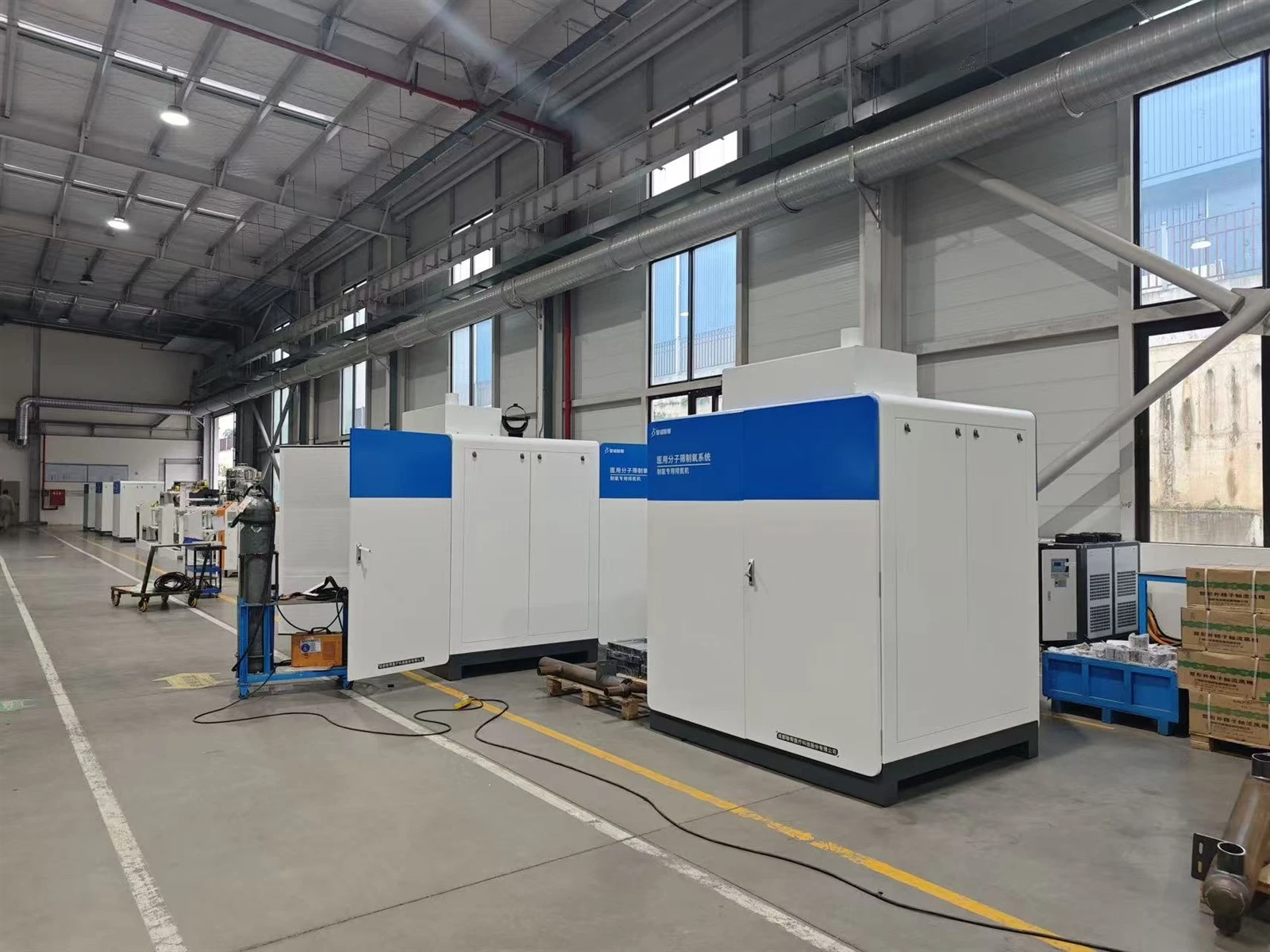
The Core Engineering Difference
PSA operates the adsorption phase at high pressure - typically 0.5 to 0.75
MPa (5 to 7.5 bar). The desorption phase happens at atmospheric pressure.
VSA operates the adsorption phase just barely above atmospheric pressure -
below 0.1 MPa. The desorption phase uses a vacuum pump to actively pull
nitrogen out of the sieve.
This single difference explains almost everything that follows: why PSA
systems are more complex to maintain, why they consume more energy, why
their molecular sieves degrade faster, and why VSA systems achieve better
long-term economics despite higher upfront cost.
Parameter 1: Compression Pressure and Energy
Compressing air is the dominant energy cost. Every 0.1 MPa increase costs
approximately 6 percent more electricity per cubic meter. PSA compresses
to 0.5-0.75 MPa. VSA compresses to below 0.1 MPa. The compression ratio
difference is roughly 5:1 to 7.5:1.
- PSA: 1.5-2.5 kW per Nm3 of oxygen produced
- VSA: 0.6-1.0 kW per Nm3 of oxygen produced
For a 40 Nm3/h system, that's the difference between drawing 60-100 kW
(PSA) and 24-40 kW (VSA). Over 8,760 hours, the energy gap adds up to
approximately 315,000-525,000 kWh per year.
Parameter 2: Oil Contamination
PSA systems almost universally use oil-lubricated screw compressors. Oil
inevitably enters the compressed air stream as vapor and aerosol at parts-
per-million levels. This creates a cascade of problems:
- Multi-stage filtration needed: coalescing filters for aerosol,
activated carbon for vapor. These are expensive consumables replaced every
3,000-6,000 hours.
- Even with filtration, trace oil reaches the molecular sieve,
progressively blocking nitrogen adsorption sites.
- Oil in the molecular sieve is essentially permanent. When performance
degrades beyond acceptable limits, you replace the entire charge at
significant cost.
VSA systems use oil-free compression. No oil in the system means no oil
filters, no oil-contaminated sieve, and roughly 10+ years of sieve life
versus 2-3 years in PSA systems.
Parameter 3: Molecular Sieve Type and Life
PSA systems typically use sodium-based or calcium-based zeolites. They
work adequately at high pressure but degrade faster - especially when
exposed to moisture and trace oil. VSA systems use lithium-based zeolites.
Lithium-LSX has higher nitrogen adsorption capacity and maintains this
capacity longer in a low-pressure, oil-free, dry environment. Typical
sieve life in VSA applications is 10-15 years.
Parameter 4: System Complexity and Maintenance
PSA systems have more components requiring regular attention: oil changes,
oil filters, separator elements, coalescing filters, carbon filters,
condensate treatment, pressure vessel inspections. A dual-unit PSA at 40
Nm3/h involves roughly 25-35 maintenance tasks per year. Annual
maintenance cost: $15,000-$25,000.
VSA systems have dramatically fewer components: no oil system, single-
stage air filtration, integrated rotary assembly, no pressure vessels. A
dual-unit VSA at 40 Nm3/h involves roughly 6-8 maintenance tasks per year.
Annual maintenance cost: $4,000-$6,000.
Parameter 5: Oxygen Recovery Rate
PSA systems typically achieve 30-45 percent oxygen recovery. VSA with
lithium sieve and vacuum desorption achieves 50-65 percent. Higher
recovery is the underlying reason VSA uses less energy: you're throwing
away less oxygen and recycling less nitrogen. The entire process is
thermodynamically more efficient.
The 15-Year View
PSA costs less to purchase - roughly $80,000-$120,000 for a dual-unit 40
Nm3/h installation. VSA costs more - roughly $140,000-$200,000. But over
15 years:
- Energy savings: $112,000-$280,000
- Maintenance savings: $165,000-$285,000
- Sieve replacement avoidance: $50,000-$80,000
- Total 15-year savings: $327,000-$645,000
The capital premium for VSA pays back in 2-3 years. Everything after that
is savings. Hospitals that have made the switch from PSA to VSA report
energy bills dropping 35-45 percent within the first billing cycle after
commissioning.
Which Technology for Which Hospital?
VSA makes clear economic sense for hospitals with 100+ beds and 24/7
oxygen demand. PSA might still make sense for very small facilities under
50 beds, or installations where the capital budget is fixed and operating
costs are someone else's problem - a budgeting distortion that exists but
shouldn't drive engineering decisions.
For everyone else, the engineering case for VSA over PSA is hard to argue
with. The data has been accumulating for 15+ years. It's consistent across
manufacturers, regions, and hospital sizes. VSA costs less to run -
substantially less - and that's the metric that matters when the equipment
runs 24/7 for two decades.